
Iredell County Court Records After a Jail Arrest
Court records after a jail arrest in Iredell County usually start after a person is booked at the Iredell County Jail & Detention Center or receives a criminal process that opens a case. The public jail side may show a name, primary charge, arrest date, booking agency, and book ID. The court side is separate: it is controlled by the North Carolina Judicial Branch and the Iredell County Clerk of Superior Court, with cases handled in District Court or Superior Court depending on the charge and procedural stage.
The District Attorney for Prosecutorial District 32, Sarah Kirkman, represents the State in criminal prosecutions for Iredell and Alexander counties. That matters because the booking charge in jail inmate records is not always the final court charge. Prosecutors may proceed on the same allegation, amend it, dismiss it, reduce it, or present a felony to a grand jury. Booking photos and photo availability are a different records question, covered on the jail roster mugshots page.
The North Carolina Judicial Branch Iredell County page is the county-level court entry point. The screenshot below comes from the official court location page at nccourts.gov/locations/iredell-county.
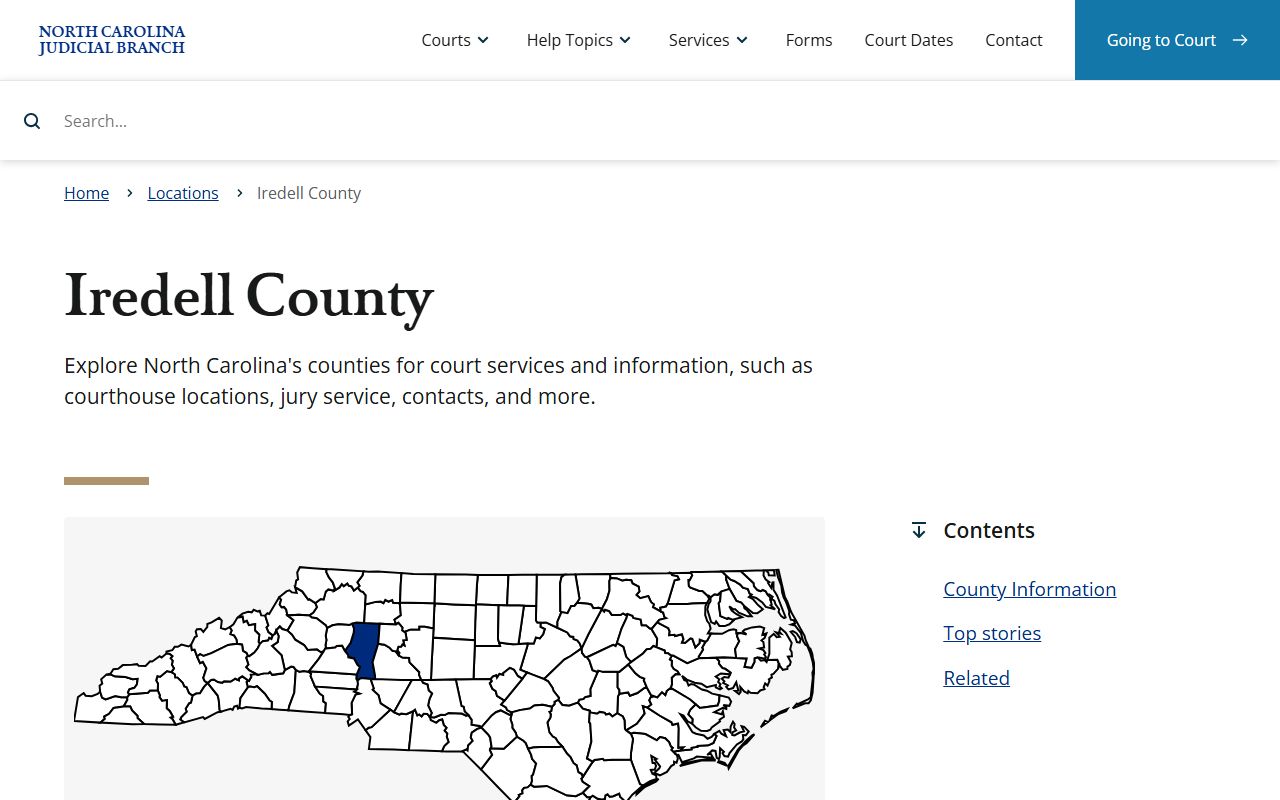
Use that court page for local court services, calendars, contact links, and the route into eCourts tools when a jail arrest has become a public criminal case.
How to Find Iredell County Court Records After an Arrest
For online access, start with the North Carolina eCourts Portal. The public portal includes Smart Search, hearing search, payment tools, and sign-in options for users with elevated access. It is the better place to look for the filed criminal case after an arrest, while the sheriff's P2C roster remains the better place to check current county custody.
- Open the eCourts Portal and choose Smart Search for a broad public case lookup.
- Search by the defendant's name or by a case number if one is known from paperwork, a citation, or a clerk notice.
- Open the matching case and compare the court charge list with the jail roster's primary charge.
- Review each charge for offense wording, case events, hearings, disposition, and any active or inactive status shown by the court system.
The Judicial Branch court-records help page says public terminals can search by defendant, case number, victim, or witness, and that paper files are kept by the clerk. In Iredell County, the Hall of Justice is at 226 Stockton Street in Statesville. The Clerk of Superior Court main number is 704-832-6600, the Criminal Department is 704-832-6602, and Magistrates can be reached at 704-832-6619. Those contacts are useful when a case is too new for online lookup, when the portal requires a CAPTCHA, or when a paper file has details not visible in the web view.
The official eCourts Portal screenshot in the manifest was captured from portal-nc.tylertech.cloud/Portal.
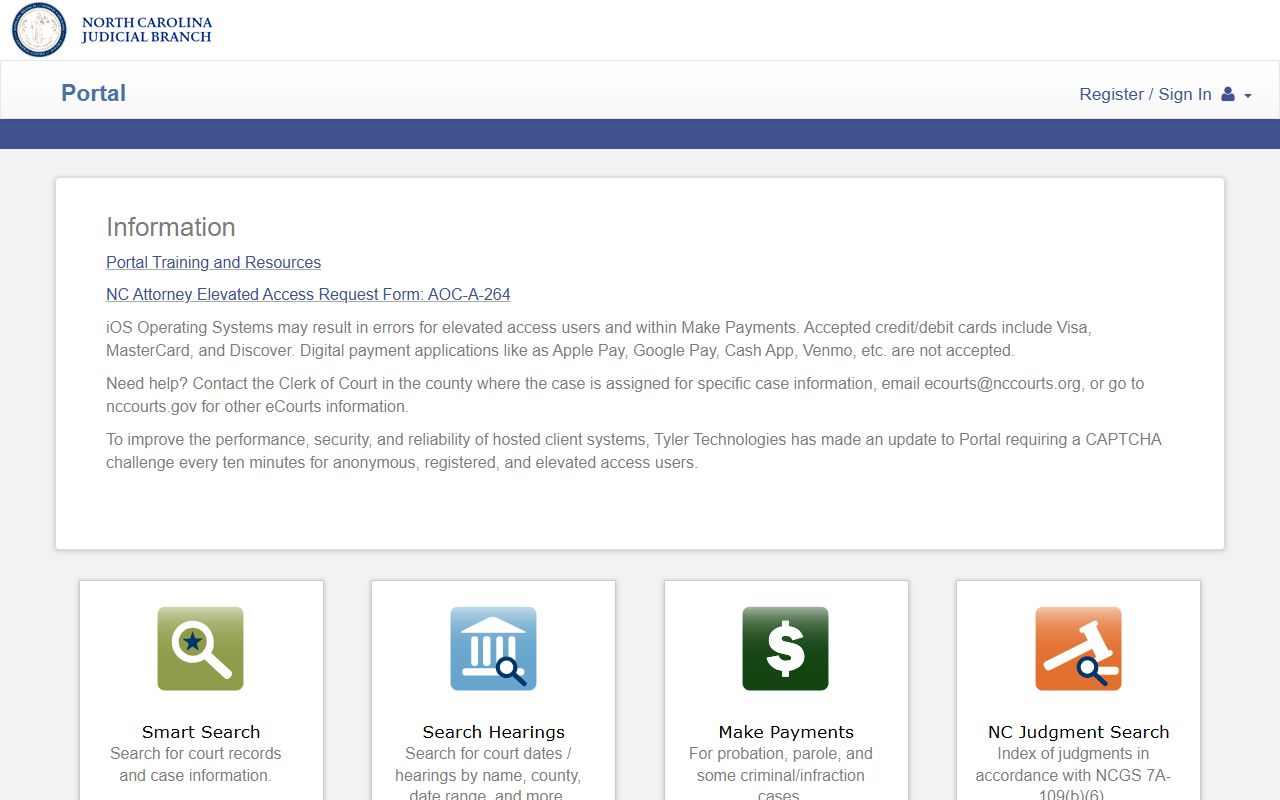
The portal is a court-record system, not a live jail roster. If the question is whether someone is still in county custody, check P2C, VINELink, or the jail information desk.
| eCourts Function | Use After a Jail Arrest | Search Notes |
|---|---|---|
| Smart Search | Find criminal case summaries and register-of-actions details. | Search by name or case number and verify identity carefully. |
| Hearing Search | Check upcoming court settings after release or first appearance. | Useful when a person has a court date but custody status is unclear. |
| Payments | Review payment routes where the court allows online payment. | Do not treat payment availability as proof that every charge is resolved. |
| Public Terminal | Access clerk-index searches and paper-file paths at the courthouse. | Use when online search is incomplete or a file must be inspected in person. |
How Charges Get Filed After an Arrest: Complaint, Information, and Indictment
The arrest-to-court path in Iredell County is not a single record. A person may be arrested by the Sheriff's Office, a municipal police department, state law enforcement, or another agency, then booked into the county jail if local custody is required. A magistrate or other judicial official handles early process and release conditions. The prosecutor then decides how the State will proceed. Formal court records after an arrest are built from charging documents, case events, and clerk entries.
| Document | Who Uses It | What It Does | Iredell County Context |
|---|---|---|---|
| Criminal complaint or citation | Officer, magistrate, or prosecutor route | Starts or supports a criminal allegation. | May be close to the charge wording first seen in P2C. |
| Criminal summons | Court process served by law enforcement | Requires a court appearance without necessarily causing a jail booking. | The Sheriff's Criminal Warrant Service Unit serves summonses received by the office. |
| Information | Prosecutor | Formal charging document used in some prosecutions. | Reflects the prosecutor's filed charge, not just the jail intake label. |
| Indictment | Grand jury | Formal felony charging document returned by a grand jury. | Can replace or refine the arrest charge as the Superior Court case moves forward. |
| Warrant or order for arrest | Judicial official or court | Directs law enforcement to take the person into custody. | May appear as a fail-to-appear, probation violation, or warrant-related booking. |
Charge Status in Court Records After an Arrest
Charges change as a case moves. The Iredell P2C grid showed examples such as probation violation, DWI, fail to appear, larceny, breaking or entering, and immigration or deportation order wording, but the roster's primary charge is only the custody-facing label captured at booking. Court records are the place to check whether the prosecutor filed the same charge, changed the charge level, added a related offense, dismissed a count, or resolved the case by plea or trial.
| Status | What It Means | How to Read It |
|---|---|---|
| Pending | The charge remains open and has not reached final disposition. | Check upcoming hearings, bond conditions, and any orders for arrest if court was missed. |
| Amended or reduced | The filed charge changed from the original allegation or moved to a lesser offense. | Compare the court charge to the P2C primary charge before drawing conclusions. |
| Dismissed | The court case or a count ended without a conviction on that charge. | A dismissal is not the same as expunction from all public systems. |
| Indicted | A grand jury returned a formal felony charge. | The indictment may have different wording from the arrest paperwork. |
| Disposed | The charge has reached an outcome such as plea, verdict, dismissal, or other final action. | Read the disposition line rather than relying on the arrest date alone. |
Bond and Release Conditions After an Arrest
North Carolina release conditions are set by a magistrate or judge, not by the online roster. Iredell research did not locate a local page publishing bond-payment instructions or accepted bond methods for every case. The practical route is to confirm current custody through the jail information desk at 704-878-3131, confirm court or magistrate information through the Judicial Branch contacts, and read any bond or release condition orders in the court record when available.
| Bond or Release Type | How It Works | Record Caution |
|---|---|---|
| Written promise to appear | The person promises to appear in court without posting money. | Confirm the next court date in eCourts or with the clerk. |
| Unsecured bond | No upfront payment is required, but money may become due for nonappearance. | Not shown in the captured P2C result grid. |
| Secured bond | Cash, property, or surety is required before release. | Verify the amount and any conditions directly before acting. |
| Surety bond | A licensed bail bondsman posts bond for a fee. | Use licensed resources, not a recommendation from an inmate-search page. |
| No-bond hold or detainer | Release is blocked by a court order or another agency hold. | Examples can include probation, another county, federal, or ICE-related holds. |
Warrants That Lead to an Arrest
The Iredell County Sheriff's Office Criminal Warrant Service Unit is responsible for service of criminal papers received by the office. The official warrant page lists criminal summonses, warrants for arrest, orders for arrest, governor's warrants, fugitive warrants, subpoenas, child-support orders, and other criminal processes. The warrant-squad contact route is the Sheriff's Office Warrant Squad Secretary at 704-878-3180, and the page says a person can respond to the Sheriff's Office or Magistrate's Office.
Returned arrest and search warrants may be public court records under North Carolina law unless sealed, but there was no official searchable Iredell warrant database field set located in the research. Use the Criminal Warrant Service Unit, the official Most Wanted PDF, P2C event and daily bulletin tools, the Sheriff's mobile app wanted-person feature, and eCourts case records as separate clues. A wanted-person list is not the same as a complete warrant database.
Charges vs. Convictions
An arrest charge or filed criminal charge is an accusation. A conviction is an outcome after a guilty plea, verdict, or other adjudication that supports a judgment. Public court records after an arrest should be read with that distinction in mind, especially when the only information first found is a jail roster row or a daily bulletin entry.
| Charge | Conviction | |
|---|---|---|
| Stage | Accusation filed or alleged after an arrest. | Final outcome through plea, verdict, or judgment. |
| Proof level | Can be based on probable cause or charging decision. | Requires the legal standard for conviction in criminal court. |
| Where found | Jail roster, warrant, citation, complaint, indictment, or eCourts case. | Court disposition and judgment entries. |
| Public meaning | Does not prove guilt. | Shows a resolved finding or plea unless later vacated or expunged. |
Sealed vs. Expunged Arrest Records
North Carolina public-records law is broad, but criminal investigation records, sealed records, juvenile matters, and expunged records require careful treatment. N.C. G.S. 15A-146 allows expunction in qualifying dismissed-charge and not-guilty situations, and G.S. 15A-153 addresses the effect of an expunction. The right route is through the court and the originating record custodian, not through informal deletion requests.
| Sealed | Expunged | |
|---|---|---|
| Public visibility | Hidden from ordinary public inspection by court order or law. | Removed or treated under North Carolina expunction rules as legally cleared. |
| Access | Limited access may remain for courts or authorized agencies. | Access is restricted according to the expunction statute and order. |
| Common trigger | Juvenile, confidential, protected, or sealed court matter. | Eligible dismissal, not-guilty finding, or other qualifying disposition. |
| Practical step | Ask the clerk about the sealing order or public-access limit. | Use the expunction order with the court or agency that maintains the record. |
Background Check Considerations
Casual court lookup is not the same as a regulated background check. Court records may be incomplete, newly filed, amended, or later expunged. A name match in eCourts or P2C should be verified against identifiers, case numbers, dates, and the originating agency before any conclusion is drawn.
Important: This website is not a consumer reporting agency and must not be used for employment, housing, credit, insurance, or other FCRA-covered decisions.
Restricted Court Records After an Arrest in Iredell County
N.C. G.S. 132-1 defines public records broadly, but G.S. 132-1.4 says criminal investigation records are generally not public records while making specific arrest information public unless another law says otherwise. That public arrest information can include the time, date, location, and nature of a violation; the name, sex, age, address, employment, and alleged violation of a person arrested or charged; and circumstances surrounding the arrest. It does not make every investigative photo, note, video, or witness statement public.
For sheriff incident or arrest documents, use the Iredell County Sheriff's Records Division. The Statesville Records Office is at 231 Constitution Lane, Statesville, and the Mooresville Records Office is at 610 E Center Avenue. For court records, use eCourts, the Clerk of Superior Court, or the public terminal and paper files at the Hall of Justice. For state prison records after sentencing and transfer, use the North Carolina Department of Adult Correction, which states that its offender search does not include county jail records.